
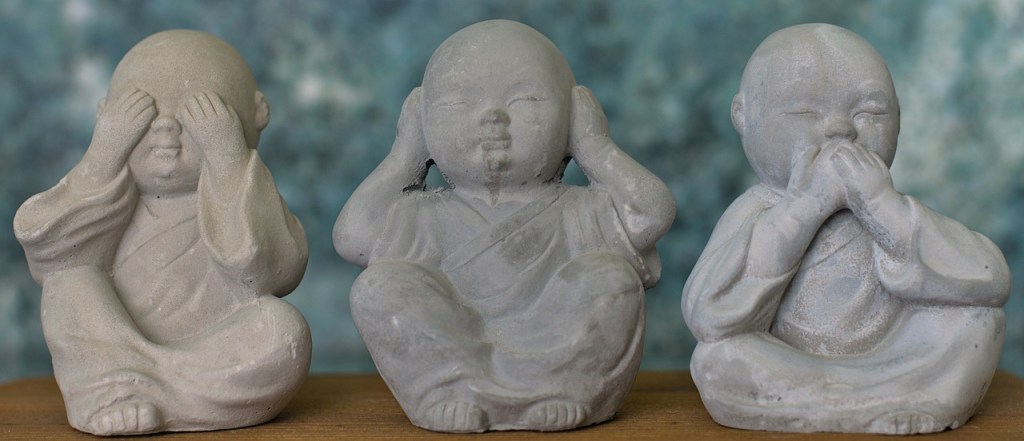
In 1996 there was a logic puzzle published in The Harvard Review of Philosophy, given the title “The Hardest Logic Puzzle Ever”. In it, there are three gods, one of whom always tells the truth, one of whom always lies, and the last of whom decides whether to tell the truth or lie at random. You are allowed to ask them up to 3 yes/no questions, and must find out their identities, with the added twist that they speak a different language than you do. In other words, they answer ‘Ja’ or ‘Da’, and you do not know which of these means ‘yes’ and which means ‘no’.
Wikipedia details a solution, and even provides a comprehensive table for every possibility given the three questions you are supposed to ask:
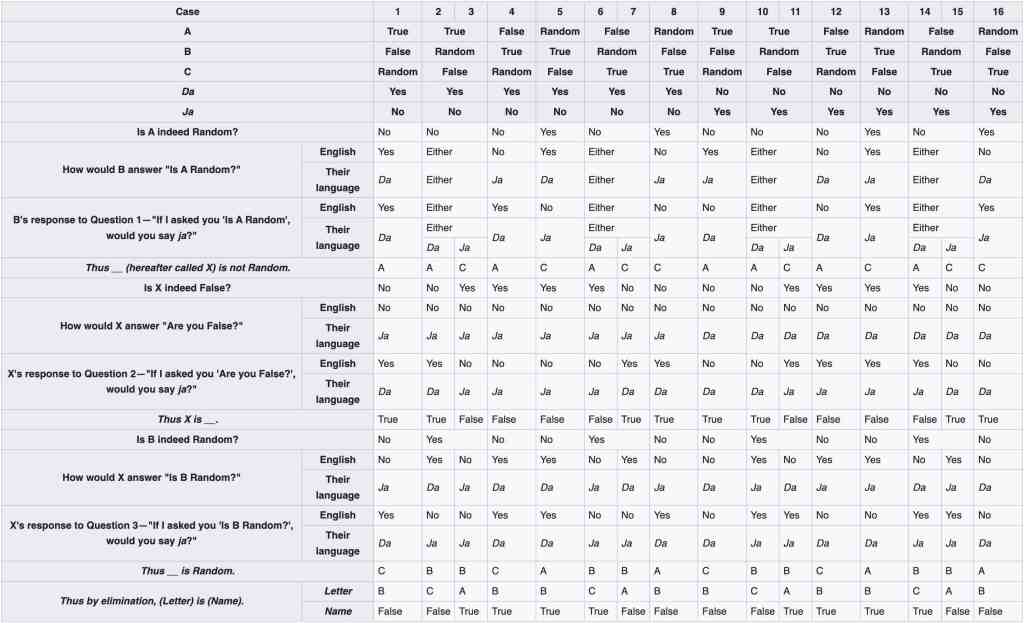
As it turns out though, you theoretically don’t even need 3 questions to get to the answer: at least, if you consider the third possibility that a god is asked an unanswerable question.
In “A simple solution to the hardest logic puzzle ever”1, B. Rabern and L. Rabern demonstrate this variant of the puzzle. If, for example, the god that speaks truth is asked: “Are you going to answer this question with the word that means no in your language?”, they cannot answer truthfully. As the paper puts it: “…they are infallible gods! They have but one recourse – their heads explode.” (emphasis mine 😛) If the original puzzle has the gods remain silent (or head explode) when presented with unanswerable questions, it can actually be solved in two questions instead of three (though becomes an even more difficult puzzle, as the modified solution questions are pretty unwieldy).
Otherwise, for those who like difficult puzzles, I would say I’ve encountered a couple of more difficult puzzles out there (at least imo). In particular, the “Demon Dance Party Riddle”2 and the Almost-Impossible Chessboard Puzzle3 are quite challenging. People may have also heard about the Zebra Puzzle4, which has been falsely attributed to both Albert Einstein and Lewis Carroll5, but I don’t think it is nearly as difficult as the others I mentioned.
Even still, I don’t think any of these would qualify as the “hardest” logic puzzle out there.
What would?
Let’s ratchet up the difficulty to the borderline impossible:
The 100 prisoners problem6 imagines 100 prisoners (numbered 1-100) and a separate room with 100 slips of paper (numbered 1-100) hidden among 100 boxes randomly. The goal is for each prisoner to enter the room one at a time, open up 50 boxes, and leave. If all prisoners are able to find their number, they are all freed, but if even a single fails to find their number, then they all remain captive. They can discuss a strategy beforehand, but no communication is allowed once they start entering the other room.
There is no way to guarantee freedom for all the prisoners, but there is an optimal strategy out there that gives ~31% success rate. This is obviously much better than the (0.5)100 = 0.0000000000000000000000000000008 chance for the simple, each-prisoner-opens-a-random-50-boxes solution. Of course, calculating these odds requires a computer, making it practically impossible to solve by hand (though you can still make an educated guess at the optimal strategy… maybe?).
We can go even further to the arguably impossible:
Imagine a godlike being generates 2 numbers. You are able to view one of them, and then you can decide to either keep this number or switch to the unseen number. How can you get a >50% chance of ending with the higher number?7
In fact there is a whole group of probability puzzles that don’t have well-defined solutions. For example, the two-envelopes problem8:
I have two envelopes with money in them, one of which has twice the amount of the second (but the values are unknown). You choose one to start with, and then are given the option to switch. If you imagine a 50% chance of switching to the doubled value and 50% chance of switching to a halved value, the naive probabilistic calculation would give you an expected value of: (0.5)*2x + (0.5)(0.5x) = 1.25x, meaning you should switch to the other envelope (expecting a 25% increase in value!). Of course, this logic once again applies, so if I give you the option to switch again, you should. And again. And… again. Until infinity.
Obviously the calculation is flawed, but HOW it is flawed is subject to a remarkable amount of discussion.
In another vein, Bertrand’s paradox9 shows how things can easily become ill-defined when talking about probabilities. Another example is the Sleeping Beauty problem10. Neither has a strict solution.
We can do even better. How about, the actually impossible?
Zen Buddhist Koans are a practice meant to provoke first doubt and then insight in students. A popular Western (mis-)understanding views them as unanswerable questions, or meaningless or absurd statements. To be fair, at first glance, they are pretty absurd. The most famous example may be Hakuin’s:
“Two hands clap and there is a sound, what is the sound of one hand?”
With a strange parallel to the probability paradoxes, these poetic puzzles don’t have simple, single answers, but can depend on interpretation11.
In Lewis Carroll’s original Alice in Wonderland, the Mad Hatter asks Alice, “Why is a raven like a writing desk?” Alice is stumped.
“Have you guessed the riddle yet?” the Hatter said, turning to Alice again. “No, I give it up”, Alice replied. “What’s the answer?”
“I haven’t the slightest idea”, said the Hatter. “Nor I”, said the March Hare.
Alice sighed wearily. “I think you might do something better with the time”, she said, “than wasting it in asking riddles that have no answers.”
For a later version, Carroll provides a ‘solution’:
“Because it can produce a few notes, tho they are very flat; and it is nevar[sic] put with the wrong end in front!”
This was not intended from the beginning though, and many other authors have put forth a variety of answers since then (some of which are quite good!)12.
That said, both of these impossible-puzzle examples lose out on the “logic” in “logic puzzle”. Math and computer science hold a host of logical problems both as-yet-unsolved or shown to be impossible to solve (i.e. prove that a given solution is correct), such as the Halting Problem13, but I wouldn’t count these as puzzles, which are presented with the intent for the responder to actually answer.
Actually, the most difficult puzzle I’ve encountered (short of the genuinely impossible) was one I was introduced to as a kid in elementary school, and whose connection to logic is strained, at best. Perhaps you’ve encountered it too?
Q: You are in a room with no windows or doors but there is light for you to see. The only objects for you to use are a mirror and a table, how do you get out of the room? (click ‘A’ for the answer)
A:
———————————————————————————
You first look in the mirror and see what you saw. Take the saw and cut the table in half. Two halves make a hole. Jump through the hole and you’re out!
———————————————————————————
Maybe “logic puzzles” are actually the easier type of puzzles, and so the hardest logic puzzle is actually of middling difficulty, all puzzles considered. The illogical ones blow it out of the water.
Hmm… the less logic involved, the more difficult the problem. There’s a life lesson in that I suppose.
- Making Gods’ Heads Explode
- Demon Dance Party Puzzle
- Almost-Impossible Chessboard Puzzle
- Zebra Puzzle (YT Video presentation, which repeats the misattribution to Einstein)
- Fun fact #1: Lewis Carroll was the first to ever publish logic puzzles, “The Game of Logic” in 1886
Fun fact #2: Lewis Carroll is his pen name, his actual name was Charles Lutwidge Dodgson - 100 Prisoners Problem
- Number Guessing Problem
Some Discussion About the Math
This is in the realm of “arguably impossible” because mathematical description requires getting into the weeds of what probability even means/represents. How do you even decide on a distribution of probability distributions from which the godlike being might be choosing its two numbers from? But without this (or assuming the generating distribution), it is impossible to mathematically show that any method indeed gives a >50% success rate. In other words, it’s impossible to prove that the number you choose in your head has a >0% chance of being between the two numbers chosen by the godlike being. It is impossible to draw from a distribution over an infinite/continuous set, so you cannot say you are choosing any rational number at random. If your friend (or any other mortal/finite being) is generating the numbers, however, you can reasonably prove the solution would work. - Two Envelopes Problem
You know it gets deep when the article has a section titled “controversy among philosophers”. As it turns out, the problem is way more intricate than some of the simple resolutions would have you believe. - Bertrand’s Paradox
In it, you’re asked to calculate the odds that a randomly chosen chord in a circle ends up being longer than the circle’s radius. Depending on how you randomly select the chord, the answer could be 1/4, 1/3, 1/2, or anything else, and there is no reason to prefer one selection method the most. - Sleeping Beauty Problem
- Koans
Victor Hori (ordained Zen monk and professor of Japanese Religion and Buddhist Studies at McGill University) explains his interpretation:
“… in the beginning a monk first thinks a kōan is an inert object upon which to focus attention; after a long period of consecutive repetition, one realizes that the kōan is also a dynamic activity, the very activity of seeking an answer to the kōan. The kōan is both the object being sought and the relentless seeking itself. In a kōan, the self sees the self not directly but under the guise of the kōan … When one realizes (“makes real”) this identity, then two hands have become one. The practitioner becomes the kōan that he or she is trying to understand. That is the sound of one hand.”
Though, according to Wikipedia, Hakuin himself introduced this question with a reference to Kanzeon (Guanyin), bodhisattva of great compassion, who hears the sounds of the suffering ones in the world, and is awakened by hearing these sounds and responding to them. To hear the sound of one hand is to still the sounds of the world, that is, to put an end to all suffering. - Why is a raven like a writing desk?
- Halting Problem
 IDenker
Leave a comment